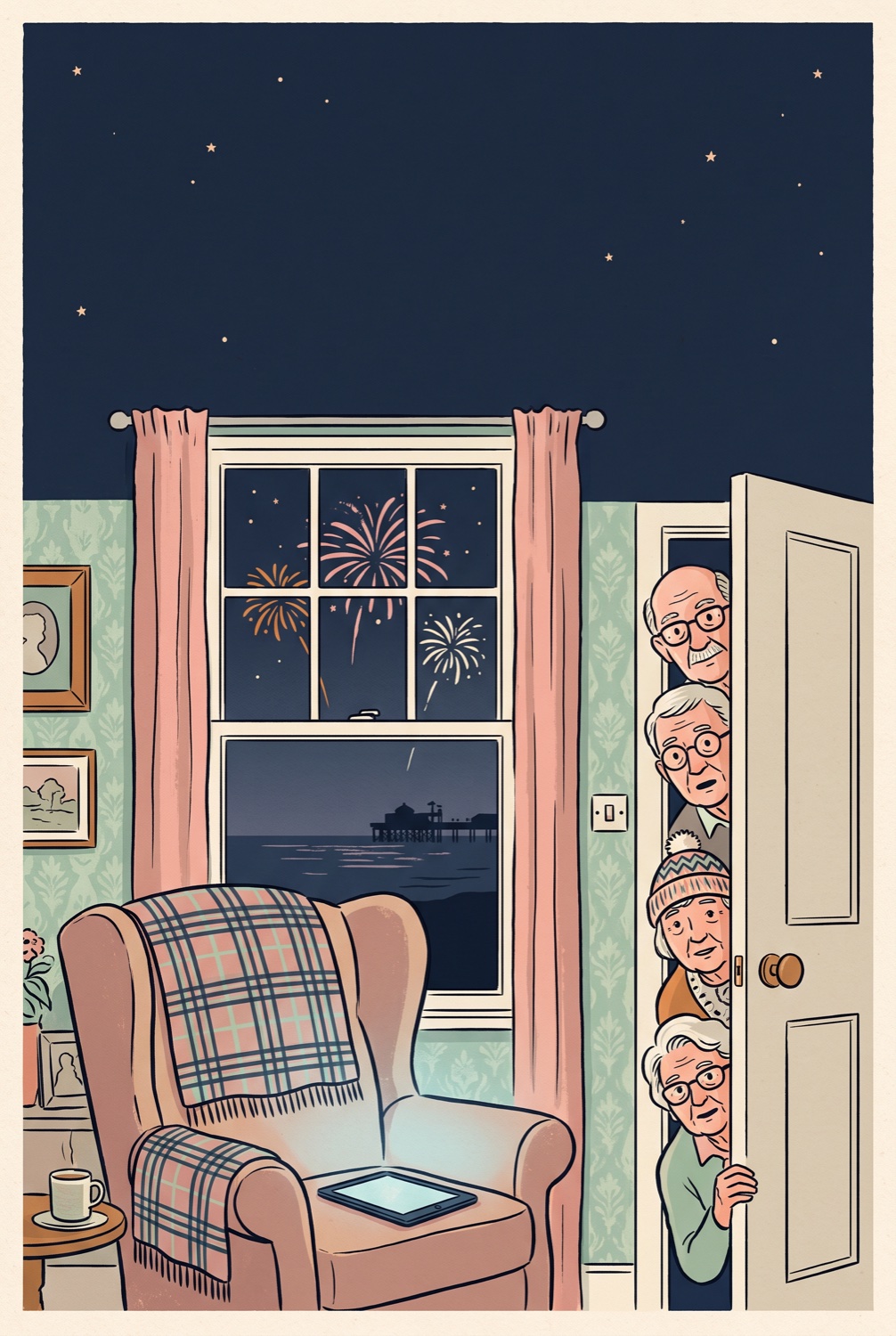
I sat down at table four with my toast, and Hector was already there with his marmalade and his own tablet, propped up against the teapot like a menu.
Hector was eighty-eight, and he had made his living for forty years by thinking about how words fit together, and he was the only person at Wrenhaven I've ever known who could be upset and interested at the same time and not apologise for either.
"Midge," he said. "Before you say anything, I'm going to play a game with the dining room. Watch."
He stood up, which takes him a while, and raised his voice. Hector has a voice that was made for reading out crossword answers to people who had got them wrong.
"Everybody! Finish this for me. Fish and…"
"Chips!" said the whole dining room.
"Salt and…"
"Vinegar!"
"Bread and…"
"Butter!"
"Thank you," said Hector, and sat down again, looking extremely pleased with himself. Barry, two tables away, said, "What did we win?" and nobody answered him.
"Now," said Hector to me, quietly. "Nobody in this room looked anything up. Nobody remembered a particular plate of fish and chips. They've just heard 'fish and' so many times in their lives that 'chips' comes out on its own. It's the likeliest next word. That's all."
"All right," I said. "And?"
"And that's what this is." He tapped his tablet. "That's all it is, Midge. A sentence-finisher. A magnificent one, I'll grant you. Far better than the dining room. It's read more words than you and I and every resident of this building could read in a thousand lifetimes, and from all that reading it's learned which word usually comes next. You give it some words. It works out the likeliest next word, and adds it. Then the next. Then the next. That's how it writes you a whole answer. One word at a time, each one the likeliest-sounding one it can find."
"It doesn't sound like it's guessing," I said.
"No. That's the trick of it." He spread marmalade, very precisely, right to the corners. "After it learned all that, they trained it some more, to make it sound like a helpful assistant. Polite. Friendly. Always answers you. It's been taught that an answer is better than no answer. So it gives you one."
"But it knew Pauline's name."
"Did it? Or did somebody put Pauline's name in front of it?" Hector looked at me over his glasses. "It isn't looking anything up, Midge. It hasn't got a filing cabinet in there. There's no little man inside it who saw what happened. It's not a recording. It wasn't watching. It was given some words, and it finished the sentence."
A demonstration
To show me, he typed into his tablet, slowly, with one finger, the way all of us do it.
Pauline came round at
Before he'd even finished, three little grey suggestions popped up along the bottom of the screen, the way they do on a phone when you're texting. the. about. 9.
"That's the keyboard doing a small version of the same trick," said Hector. "Those are its guesses for the next word. Nothing more. If I tap one, it'll guess the one after. If I keep tapping, it'll write Pauline a whole evening. The assistant does exactly this, only far better, and with a much bigger memory for how people write."
He tapped about. Then 9. Then o'clock. Then to. The sentence grew on the screen like a weed, perfectly confident and completely made up.
Pauline came round at about 9 o'clock to see me and we
He stopped. "You see? It'll go on all day. It sounds like a witness. It isn't one."
I looked at the screen for a long time.
Then he said something that I wasn't ready for.
"Same with those captions, by the way. The ones that write down what people are saying. It's the same trick. It hears sounds and picks the likeliest words. When the sound is muffled, or someone has an accent it doesn't know very well, it still picks a word. Just not always the right one."
My handbag was on my knee. The clasp was undone about half an inch. I put my hand over it without meaning to, the way you put your hand over a cut.
Hector didn't look at the handbag. Hector looked at his marmalade. I have never been so grateful to a man for not noticing something.
At lunch, Hector slid a paper napkin across the table to me. He'd written on it in his crossword capitals, the way he used to write clues.
ONE QUESTION, MIDGE
When the tablet told the detective that Pauline came round at twenty to ten, what was it actually doing?
Full marks. Turn the page.